

Roami AI In-Car Companion Brand & Product Site
Designing for emerging tech
Background
Driving is emotional. It’s the isolation of a long commute, the sudden panic of a warning light, or the shock of a collision.
Most drivers don’t have built-in AI systems in their cars, and the tools available today fall short when those moments actually matter. Dashcams record silently in the background. Telematics apps primarily benefit insurers, not drivers. Voice assistants offer help only when prompted.
None of these solutions provide reliable support through accidents, roadside issues, or the insurance process that follows. And many of these tools feel opaque or intrusive, making trust difficult to establish in moments of vulnerability.
THE CHALLENGE
I led the brand, web experience, and design system for Roami during its development, defining the visual language and storytelling ahead of the product’s completion. Establishing this foundation early was critical to shaping clarity, trust, and alignment as the product evolves, with more work planned as it matures.
MY ROLE
The North Star of Roami Experience
Protection without surveillance. Support that feels present, not intrusive. Personalization without friction.
Product strategy: agency, calm, and emotional safety.
Agency Over Automation
Every interaction gives the user control. Every permission is opt-in. Insurance integration is a perk, not a requirement.
Calm Technology
A car is already a high-stimulus environment. Roami surfaces information only when it matters. It provides soft ambient light. Its expressions are subtle and human. It alerts only in meaningful contexts.
Trust Built Through Reward
Roami rewards good driving. It celebrates safe habits, and turns insurance into empowerment rather than surveillance. Reframes it from “judge” to “co-pilot.”
Brand tone: soft, warm, and human. Convey the beauty of the journey.
The first touchpoint of Roami isn’t the product itself, it’s the feeling of being accompanied. I designed the brand to convey warmth, steadiness, and subtle optimism, the way headlights cut through fog or dusk reflects off a windshield.
Color Palette
The Roami color palette is built around Sazerac as the primary foundation, chosen for its open quality that gives the interface room to breathe and keeps the experience unobtrusive. Starship and Tana provides an emotional counterweight. It’s energetic and aspirational: the “light on the road ahead.” Wisteria and Chambray add depth through accent states, icons, and interface gradients, helps draw attention to key product moments and details, creating visual focus without being overwhelming.
Typography
Poppins for headings humanizes the brand, it’s approachable, modern, and easy to scan at a glance. Sora’s geometric structure creates open, readable letterforms at small sizes, while its humanist details soften the shapes.
Graphic Elements
The soft shapes were inspired by light: brake halos at dusk, LED reflections on asphalt, fog beams against wet pavement. They communicate motion, presence, and the emotional texture of travel. They serve as anchors through the page, easing the cognitive load of technical information.
Logo Process
Using a face in Roami’s logo humanizes the brand and makes travel feel personal. It suggests companionship and presence, like a friend guiding you through unfamiliar places.
Website design: turning complexity into a story
Creating Roami’s website was an exercise in emotional pacing. The goal wasn’t to overwhelm people with technical detail or hardware specs. It was to tell a story about safety and companionship, making AI feel approachable and gently guiding users toward the moment of purchase.
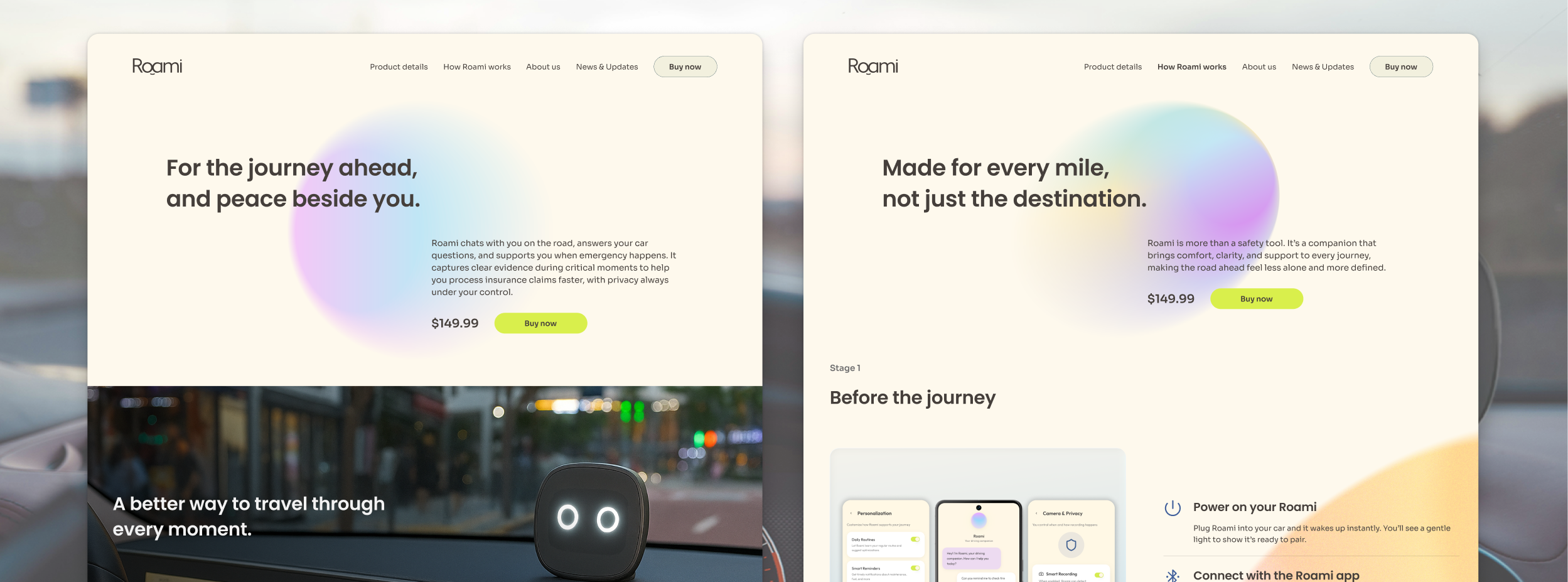
Overview of the end-to-end web experience
Visuals and textures along the journey
The opening hero on all pages establish the presence of Roami. Throughout the page, the soft ambient gradients and glass textured cards echo the visual sensation of headlights through fog or dusk reflections on car windows. The gradients also reflect the passage of time, as they get deeper when the page goes on.
Homepage (scrollable prototype)
As the first entryway of the website, it tells an emotional and practical promise. Direct benefits, product features at a glance, and social proof help make the concept safe and attractive.
Product details page (scrollable prototype)
This page is structured as a modular overview, designed to let users quickly understand Roami. It opens with a high-level introduction to establish context, then moves into distinct sections, connecting the physical device, digital experience, the insurance ecosystem into a coherent story.
How it Works (scrollable prototype)
This page explains Roami’s behavior at the moments a driver would care: before the journey, during the journey, and after the journey, emphasizing reassurance, clarity, and continuity.
News & Updates (scrollable prototype)
This page was designed as an editorial hub that supports Roami’s evolving product and brand. It brings together product updates, road-level insights, and community stories in a scannable layout. This page reinforces trust by showing how Roami evolves and adapts.
The long term goal of Roami is to improve how insurers assess risk and how drivers experience everyday life behind the wheel.
For insurance partners
Fewer incidents: Contextual coaching, hazard alerts, and maintenance reminders reduce risk. Roami could create sustained behavior change.
Faster claim processing: Clear crash footage and event metadata reduce ambiguity and investigation time. Can help settle claims faster and reduce fraud.
Better underwriting: Insurance linking is optional but powerful, when users opt in, insurers gain a privacy-governed stream of safety signals, which supports: fairer pricing and safe-driver perks, helps create higher loyalty and retention.
For users
Reduced anxiety before driving: Routines and service reminders. No “guessing” dashboard warnings.
Immediate support after incidents: When a crash happens, Roami’s emergency responds activates automatically. When the driver can’t speak or interact, the device calls help based on their preset plan and provides evidence for faster claims.
Privacy remains in their control: Camera recording is optional. Users will always have privacy under their control.